
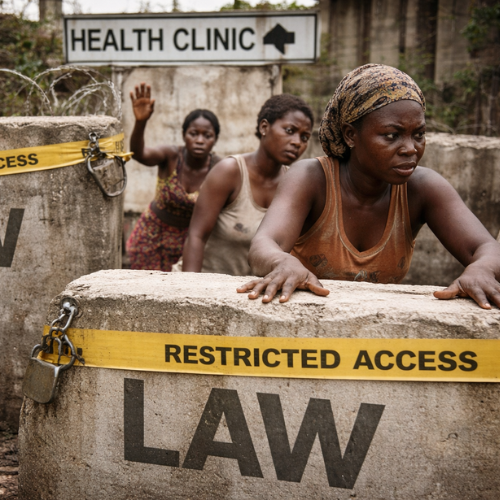
One of the most persistent challenges in advancing sexual and reproductive health and rights (SRHR) in Africa is not the absence of law, but its inconsistency. Across many jurisdictions, women and girls navigate a complex legal maze where different laws say different things within the same legal system. The result is confusion, irregularity, and harm.
Consider an adolescent girl seeking reproductive healthcare. Health policy may encourage access to services, while criminal law penalizes sexual activity involving minors. Providers, fearful of legal consequences, respond by denying care altogether. In theory, the law exists to protect her; in practice, it leaves her unprotected. This is a structural problem.
These contradictions often arise from fragmented law-making. Criminal law, health law, child protection frameworks, customary norms, and constitutional rights frequently evolve in silos. Without deliberate harmonization, they produce legal uncertainty. For women and girls, this uncertainty translates into arbitrary enforcement, stigma, and exclusion. For service providers, it creates fear and defensive practices. For the justice system, it undermines credibility.
From a rule of law perspective, this is concerning. One of the core principles of the rule of law is legal certainty the idea that laws should be clear, predictable, and consistently applied. When individuals cannot reasonably understand their rights or obligations, the law ceases to function as a tool of justice. Instead, it becomes a site of power and discretion, often exercised against those already marginalized.
The consequences are especially severe for survivors of violence. Laws may promise protection and remedies, yet procedural gaps, evidentiary standards, and cultural biases combine to deny meaningful justice. Survivors are asked to navigate systems that were not designed with their realities in mind. In such contexts, legal contradictions are not technical errors; they are lived injustices.
Addressing this problem requires more than isolated reforms. It demands a holistic approach to law and policy, one that is survivor centered, and focuses on reproductive justice, coherence, and lived experience. Law reform must be intentional, intersectional, and survivor centered. Courts must interpret laws in ways that advance rights rather than restrict them. Policymakers must resist moral panic and instead focus on clarity, protection, and accountability.
As Africa continues to strengthen its legal frameworks on SRHR and gender justice, coherence and consistency must be a priority. Laws should work together, not against the people they are meant to serve. Until they do, women and girls will continue to bear the cost of legal contradiction not as abstract subjects, but as real people navigating real harm.