
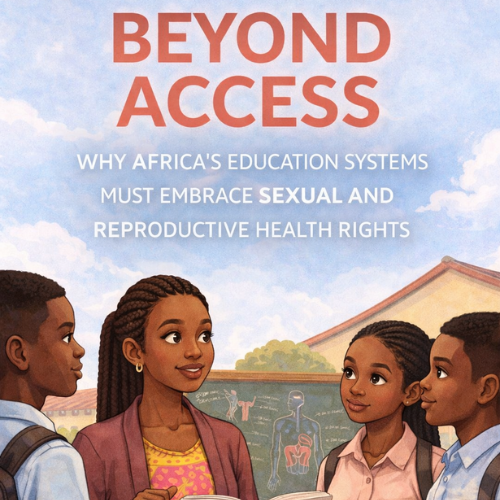
As the world marks the International Day of Education, Africa stands at a crossroads. On one hand, governments continue to affirm education as a cornerstone of development, investing in enrolment, infrastructure, and digital learning. On the other, millions of African children, particularly girls and adolescents, remain locked out of the full promise of education because sexual and reproductive health and rights (SRHR) are treated as controversial, negotiable, or optional.
Even though SHRH shapes educational access, retention and outcomes, there is still a great unwillingness to address the intersectionality between Education and SRHR.
Across Africa, school attendance statistics tell only part of the story. Beneath the numbers lie harsh realities: adolescent pregnancy, child marriage, sexual violence, and limited access to reproductive health information continue to disrupt education for girls and young people. According to UN data, sub-Saharan Africa has one of the highest rates of adolescent pregnancy, having twice the global average, with over 100 births per 1,000 women, in 2021. For many girls, pregnancy still marks the end of their education, not because they lack ability or ambition, but because systems are designed to exclude them.
In recent years, several African countries have taken steps toward progressive education and re-entry policies for pregnant learners and young mothers. Yet implementation remains uneven, undermined by stigma, weak enforcement, and conflicting legal and policy frameworks. In some contexts, education policies promise inclusion while criminal laws, school regulations, or moral policing actively punish the same learners they claim to protect. The result is a legal and social maze that girls must navigate alone.
The absence of comprehensive, age-appropriate sexuality education is a central driver of this crisis. While African governments have repeatedly committed to comprehensive sexuality education (CSE) through regional frameworks such as the African Union’s Continental Education Strategy for Africa (CESA) and the Maputo Protocol, these commitments are increasingly under attack. Under the guise of protecting culture or religious beliefs, SRHR education is mischaracterized as foreign, dangerous, or immoral.
This backlash is not happening in a vacuum. It mirrors global trends where SRHR is becoming a political battleground, with funding cuts, restrictive policies, and growing influence of conservative movements shaping national agendas. In Africa, these global dynamics intersect with local inequalities, weak education systems, and under-funded health services heightening their impact on young people.
The consequences are visible in classrooms and communities. Learners lack basic information about puberty, consent, contraception, and sexual health. Myths thrive where knowledge is suppressed. Silence replaces support. Girls are blamed for pregnancies they were never equipped to prevent. Survivors of sexual violence are expected to return to school without care, justice, or accommodation. Education, in these circumstances, becomes an exercise in endurance rather than empowerment.
Yet evidence consistently shows that comprehensive sexuality education works. It delays sexual debut, reduces unintended pregnancies, improves health outcomes, and strengthens educational attainment. More importantly, it affirms young people as rights-holders capable of making informed decisions about their bodies and futures.
The International Day of Education should therefore prompt a harder question: what kind of education is Africa delivering? An education that avoids SRHR does not protect young people; it abandons them. An education system that teaches mathematics and science but refuses to address bodily autonomy, gender equality, and consent is incomplete and, ultimately, dishonest.
Education and SRHR cannot be siloed into separate ministries, budgets, or moral debates. They are mutually reinforcing pillars of development, public health, and human rights. Governments must align education, health, and justice policies to ensure that learners can access accurate information and services without fear of punishment or exclusion.
Civil society, educators, parents, and faith leaders also have a role to play. Protecting culture should not mean sacrificing truth, safety, or dignity. African values have always included care, community, and responsibility principles that align with, rather than oppose, rights-based SRHR education.
As we commemorates the International Day of Education, celebration without courage is not enough. The continent’s future depends not just on getting children into school, but on ensuring that education equips them to live healthy, informed, and autonomous lives.
Education that excludes sexual and reproductive health and rights is education that leaves too many behind.