
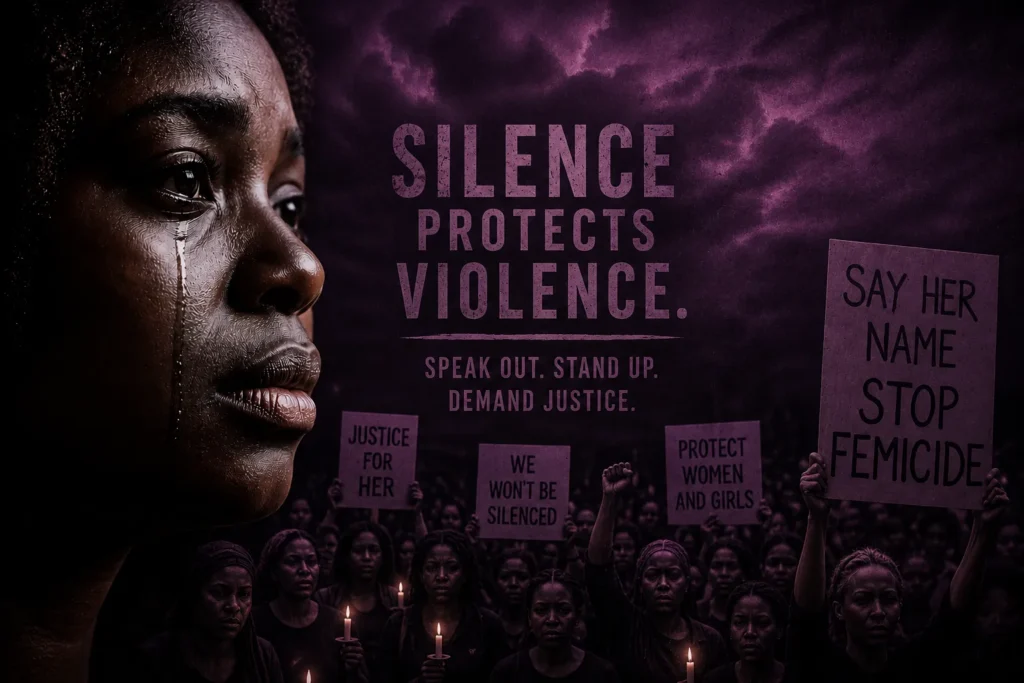
A woman is reportedly killed every day in Kenya. The rate of femicide is continuously increasing despite the outcry that has continuously been there, not only from civil society and feminist groups, but from women themselves. Yet even this stark reality fails to fully capture the depth of the crisis. It is not only adult women who are being killed. Young girls, some as young as seven years old, are being raped and murdered, their lives cut short in acts of violence that reflect both brutality and systemic neglect.
These are not isolated tragedies. They are part of a pattern.
Recent cases across the country reveal a disturbing consistency: women and girls are most often killed by people known to them, intimate partners, relatives, or acquaintances. Homes, which should be spaces of safety, have become sites of danger
A recent joint statement by civil society organizations, describes femicide and violence against women and girls as having reached “crisis levels” requiring urgent national intervention. The accounts shared are harrowing, women strangled, stabbed, burned, and subjected to degrading treatment even in death. These are not just criminal acts; they are violations of the most basic human rights: the right to life, dignity, and security.
Kenya does not lack laws. The Constitution guarantees equality, freedom from discrimination, and the right to life and dignity. Statutes such as the Sexual Offences Act and the Protection Against Domestic Violence Act exist to protect women and girls. But the persistence of femicide exposes a fundamental truth: laws alone are not enough. Without implementation, enforcement, and accountability, legal frameworks become hollow promises.
One of the most significant gaps is the failure to recognize femicide as a distinct crime. Currently, these killings are recorded as homicides, erasing the gendered nature of the violence. This not only obscures the scale of the problem but also weakens the ability to develop targeted prevention and response strategies. Underreporting and misclassification make it nearly impossible to track femicide accurately, leaving many cases invisible in official data.
In response to growing public pressure, the government established a Technical Working Group on Gender-Based Violence, including femicide. While this was a necessary step, it cannot be the end of the conversation. The real question is: what comes after the task force?
Reports have been written. Recommendations have been made. Yet the numbers continue to rise.
What is missing is urgency.
Declaring femicide a national crisis is not merely symbolic. It would signal political will, unlock emergency resources, and prioritize coordinated action across government agencies. Establishing survivor-centered response systems, shelters, legal aid, psychosocial support, is critical to ensuring that those at risk have somewhere to turn before violence escalates to fatal outcomes.
Equally important is accountability. Many victims had previously sought help from authorities but were ignored or redirected. This failure to act is not just administrative, it is a breach of duty. The State has a legal obligation to prevent, investigate, and respond to violence. When it fails to do so, it becomes complicit in the conditions that allow such violence to persist.
There must also be a shift in how society understands femicide. This is not just about individual perpetrators. It is about power, control, and deeply entrenched gender inequalities that normalize violence against women and girls. Addressing femicide requires more than reactive measures; it demands structural change.
If meaningful action is not taken courts may soon be called upon to determine whether the State’s inaction constitutes a violation of constitutional rights. Such litigation could redefine accountability and compel systemic reform.
But litigation should not be the first resort. It should be the last.
Kenya stands at a crossroads. The establishment of the task force was an acknowledgment of the problem. What comes next will determine whether it was also the beginning of the solution or just another missed opportunity.
Because every delay has consequences.
Every delay costs lives.
And for the women and girls of Kenya, the cost is already too high.
Declaring femicide a national crisis is not merely symbolic. It would signal political
will, unlock emergency resources, and prioritize coordinated action across
government agencies. Establishing survivor-centered response systems, shelters,
legal aid, psychosocial support, is critical to ensuring that those at risk have
somewhere to turn before violence escalates to fatal outcomes.
Equally important is accountability. Many victims had previously sought help from
authorities but were ignored or redirected. This failure to act is not just
administrative, it is a breach of duty. The State has a legal obligation to prevent,
investigate, and respond to violence. When it fails to do so, it becomes complicit in
the conditions that allow such violence to persist.
There must also be a shift in how society understands femicide. This is not just about
individual perpetrators. It is about power, control, and deeply entrenched gender
inequalities that normalize violence against women and girls. Addressing femicide
requires more than reactive measures; it demands structural change.
If meaningful action is not taken courts may soon be called upon to determine
whether the State’s inaction constitutes a violation of constitutional rights. Such
litigation could redefine accountability and compel systemic reform.
But litigation should not be the first resort. It should be the last.
Kenya stands at a crossroads. The establishment of the task force was an
acknowledgment of the problem. What comes next will determine whether it was
also the beginning of the solution or just another missed opportunity.
Because every delay has consequences.
Every delay costs lives.
And for the women and girls of Kenya, the cost is already too high.